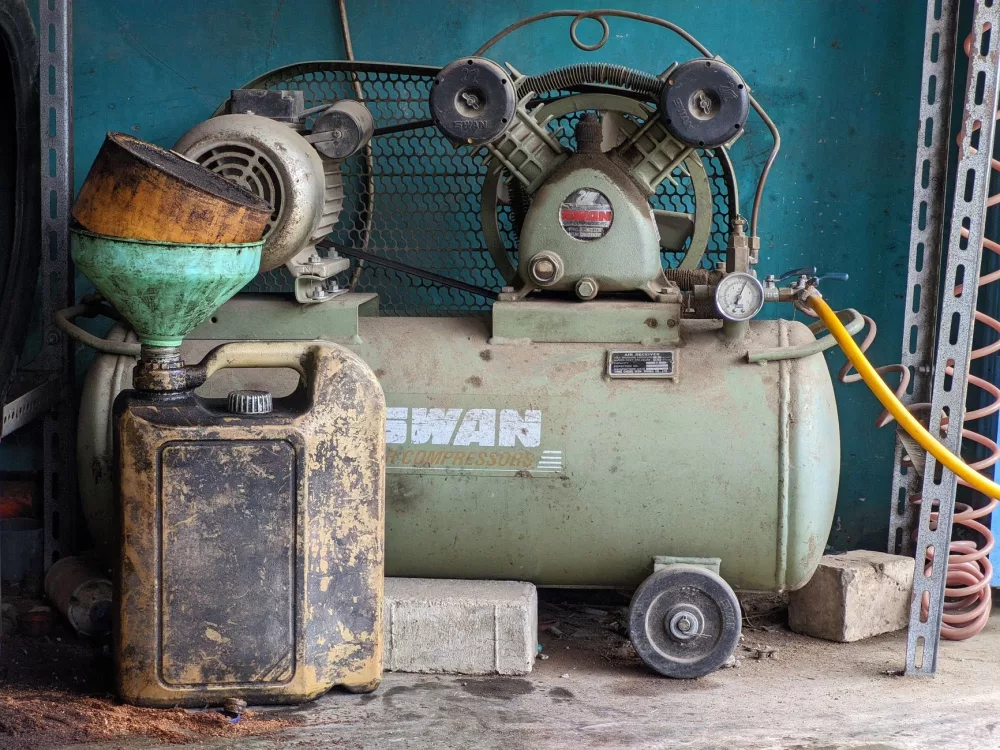
When you really stop to think about it, air is literally everywhere around us. It's an invisible, boundless resource. But what if I told you there's a machine that takes this everyday element and turns it into a powerful, versatile workhorse? I'm talking, of course, about the air compressor. It's an incredible piece of engineering that I've always found fascinating, quietly powering countless tools and processes in homes, workshops, and massive industrial complexes worldwide. You'd be surprised just how many things rely on compressed air to function.
What Exactly Is an Air Compressor?
At its core, an air compressor is a mechanical device designed to increase the pressure of air by reducing its volume. Think of it like this: it sucks in ambient air, compresses it into a much smaller space, and then stores that high-pressure air in a tank. When you need it, that stored energy is released, providing a forceful, consistent stream of air that can be used to power various tools or perform specific tasks. It’s essentially converting raw atmospheric air into potential energy, ready to be unleashed. I find it pretty neat how something so common can be harnessed so effectively.
How Do These Marvels Work? The Inner Workings
Let me break down the basic principle of operation. Most compressors use a motor (either electric or gasoline-powered) to drive a mechanism that compresses the air. This mechanism could be a piston, a rotating screw, or even impellers. As air is drawn in, it's pushed into a smaller chamber. The molecules get closer together, increasing their kinetic energy and, consequently, the air pressure. This pressurized air then travels through a valve and into a storage tank. There's often a pressure switch that monitors the tank's pressure; once it hits a pre-set maximum, the motor shuts off. When the pressure drops due to air consumption, the motor kicks back on to replenish the supply. It’s a beautifully simple, self-regulating system.
A Look at the Different Types of Air Compressors
You might think an air compressor is just an air compressor, but there's actually a whole family of them, each designed for different needs and scales. We're talking about a significant variety, and understanding them helps you pick the right one for your specific job.
- Reciprocating (Piston) Compressors: These are probably what most of us picture. They use a piston moving up and down within a cylinder to compress air. You'll find two main types:
- Single-Stage: Air is compressed once. These are common for smaller, intermittent tasks like inflating tires or using a nail gun at home. They're usually more affordable and run on standard household current.
- Two-Stage: Air is compressed twice, achieving higher pressures. These are often seen in auto shops or light industrial settings, powering impact wrenches or sandblasters. They're more efficient for heavy-duty, continuous use.
- Rotary Screw Compressors: These are the workhorses of many industrial operations. Instead of pistons, they use two intermeshing helical screws that rotate, trapping air between them and compressing it as the volume decreases. They deliver a continuous, pulsation-free flow of air and are incredibly energy-efficient for constant, high-demand applications. If you've ever seen a factory floor, chances are they're using one of these.
- Centrifugal Compressors: For the really big jobs, we've got centrifugal compressors. They use a rotating impeller to accelerate air, then convert that velocity into pressure. These are massive machines, typically found in very large industrial settings like power plants, chemical facilities, or steel mills, where a huge volume of high-pressure air is needed continuously. You certainly wouldn't find one of these in your garage!
Where Do Air Compressors Shine? Their Myriad Applications
The applications for compressed air are truly staggering. It's not just for inflating tires, believe me. Here are just a few areas where these machines are absolutely indispensable:
- Automotive Industry: From powering tire changers and impact wrenches in repair shops to operating spray paint guns for car finishes, compressors are foundational here.
- Construction: Think jackhammers breaking concrete, nail guns rapidly fastening materials, or even specialized equipment for roadwork. Compressed air is tough and reliable.
- Manufacturing and Industrial Use: This is where they really show their muscle. Air compressors power pneumatic tools on assembly lines, operate robotic arms, control automated machinery, and are critical for processes like sandblasting, plasma cutting, and even packaging.
- DIY and Home Use: Many homeowners use smaller compressors for inflating sports equipment, blowing dust off tools, operating airbrushes for crafts, or powering air nailers for home improvement projects. They're incredibly handy to have around.
- Medical and Dental: High-purity, oil-free compressors are vital for operating dental drills, ventilators, and other medical equipment, ensuring patient safety and precise operation.
Choosing the Right Compressor: What You Really Need to Consider
So, you're thinking about getting one? It's not as simple as just grabbing the first one you see. There are a few key specs and features that I always tell people to look at very carefully.
- CFM (Cubic Feet per Minute): This tells you how much air the compressor can deliver at a certain pressure. Your tools will have a CFM requirement, and your compressor needs to meet or exceed that for optimal performance. I always advise getting a compressor with slightly higher CFM than your most demanding tool to ensure continuous operation.
- PSI (Pounds per Square Inch): This indicates the maximum pressure the compressor can produce. Again, match this to your tool requirements. Most common air tools need around 90 PSI.
- Tank Size: A larger tank means the compressor runs less frequently, which is great for continuous use of air-hungry tools. A smaller tank is more portable but will cycle more often. Think about how long you'll be running tools without interruption.
- Power Source: Electric compressors are common for home and shop use, available in 120V or 240V. Gas-powered compressors offer portability and higher power for remote job sites where electricity isn't readily available.
- Portability vs. Stationary: Do you need to move it around, or will it stay in one spot? Smaller tanks and wheels make a compressor portable.
- Noise Level: Some compressors, especially oil-lubricated piston types, can be quite loud. If you're working in a confined space or have neighbors close by, a quieter, oil-free model might be a better choice.
Regular maintenance, like draining the tank to prevent rust and checking air filters, is crucial for longevity and performance, no matter which type you choose. It's a small effort for a long-lasting machine.
Ultimately, the air compressor is an unsung hero of our modern world. From tiny hobby projects to massive industrial operations, its ability to convert simple air into powerful, controllable energy is nothing short of remarkable. It's a testament to ingenuity and a constant reminder that sometimes the most powerful forces are the ones we can't even see.